Key Takeaways
- Use warm water (65-80°C) – not boiling – for the clearest results with liquid Shilajit.
- Pure liquid Shilajit dissolves fully within 2-5 minutes into a golden-amber or dark brown uniform solution.
- No persistent residue, no thick foam after shaking, and no filter residue are all positive signs.
- Minor fine mineral specks can appear in genuine Shilajit – look for gritty or oily sediment as the real red flag.
- The warm water test is a useful screen, not a replacement for a third-party Certificate of Analysis.
- For Indian buyers: FSSAI registration and a NABL lab COA are the strongest credibility signals to look for.
- Combining the water test with the pliability and alcohol tests gives a much more reliable home assessment.
If you’ve recently bought a bottle of liquid Shilajit – or you’re weighing your options and reading the label with some scepticism – you’re asking the right questions. The Indian market for Himalayan Shilajit has expanded rapidly, and with that growth has come a predictable surge in adulterated products: resin diluted with coal tar, fulvic acid concentrates sold as the real thing, or simply dark molasses dressed up in a nice jar.
The warm water purity test isn’t a foolproof laboratory analysis. But it is one of the oldest, most accessible, and most telling first checks you can do at home – and when you know exactly what you’re looking for, it tells you a lot. This guide walks through the precise method for liquid Shilajit specifically, explains the science behind each observation, and tells you honestly what the test can and cannot confirm.
What Makes Liquid Shilajit Different From Resin?
Pure Himalayan Shilajit starts as a thick, tar-like resin that oozes from rock fissures at high altitudes in regions like Jammu & Kashmir, Uttarakhand, and Himachal Pradesh. Liquid Shilajit is that same resin, either diluted to a more pourable consistency with purified water or processed to a lower viscosity. This matters for the water test because liquid Shilajit naturally disperses faster than a dense resin pellet – so if you’ve used resin-based instructions before, there are a few differences worth noting.
The primary active compounds in authentic Shilajit – fulvic acid, humic acid, and a complex of trace minerals – are water-soluble. That’s the biochemical reason this test works at all. Fulvic acid is a small organic molecule that disperses readily in warm water, creating that characteristic golden-to-dark-brown solution that genuine Shilajit produces. Adulterants like clay, coal, heavy fillers, or synthetic colourants behave very differently.
What You’ll Need to do Water Purity Test for Liquid Shilajit
- A clear glass or transparent mug
- Warm water – ideally 65-80°C (if you don’t have a thermometer, water that feels hot but not boiling is about right)
- A small spoon or stirrer
- The liquid Shilajit you want to test (a few drops – 200-300 mg is sufficient)
- Optionally: a coffee filter or fine muslin cloth, a phone torch
“One thing many people overlook is that tap water can sometimes leave its own mineral residue. If you want a cleaner read, use filtered or purified water.”
The Warm Water Purity Test: Step by Step
01 Prepare Warm Water
Fill your clear glass with approximately 200 ml of warm water (65-80°C). Don’t use boiling water – extreme heat can sometimes alter the visual properties and makes observation harder. You want the water clearly warm to the touch but not actively steaming.
02 Add the Liquid Shilajit
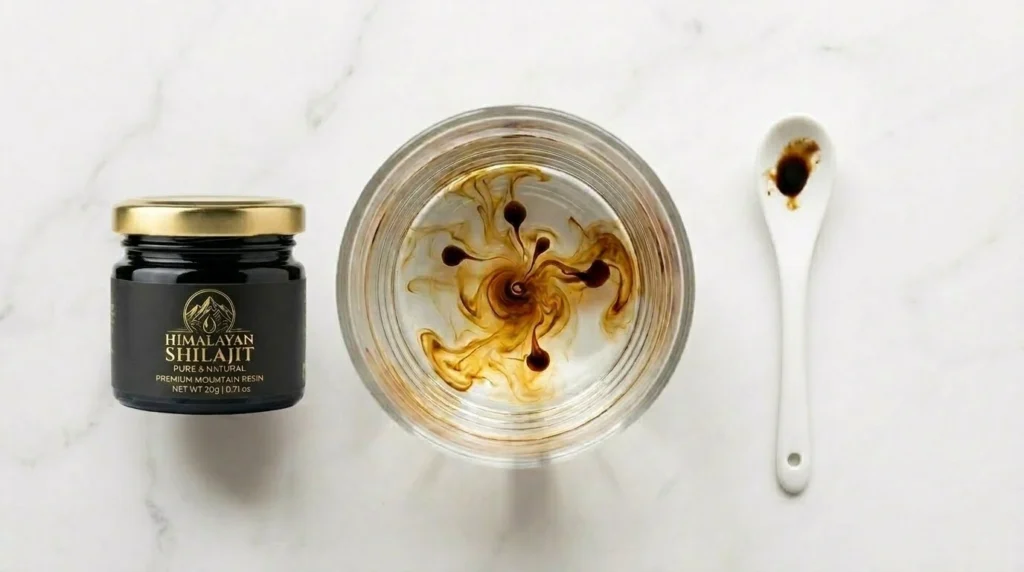
Add 3-5 drops, or approximately a quarter teaspoon of liquid Shilajit into the water. Don’t stir yet – let it sit for 30 seconds and observe what happens naturally. Does it begin to disperse on its own? Does it sit on top of the water? Does it form a cloudy blob and sink?
03 Observe Initial Dissolution
Pure liquid Shilajit will begin dispersing into the water almost immediately, creating a wisp of dark colour that spreads outward. Within 2–3 minutes of gentle stirring, it should dissolve completely into a uniform golden-brown, amber, or dark reddish-brown solution with no visible clumps or film on the surface.
04 Check for Residue
After full dissolution, hold your glass up against a light source (your phone torch works perfectly). The solution should be uniform. Look carefully at the bottom and walls of the glass for any gritty sediment, sandy particles, or an oily sheen on the surface. These are signs of fillers or impurities.
05 The Shake Test (Foam Check)
Cover the glass and give it a firm shake for 20-30 seconds. Authentic Shilajit solution should produce minimal to no persistent foam. If you see a thick, long-lasting layer of foam forming on the surface, this indicates the presence of foaming agents – a red flag for adulteration. A few small bubbles that disappear quickly are completely normal.
06 Optional: The Filter Test
Pour the dissolved solution through a coffee filter or piece of fine muslin cloth. Pure Shilajit should pass through cleanly, leaving no visible residue on the filter. Gritty brown or sandy material caught in the filter is a strong indicator of clay, rock dust, or other adulterants.
How to Read Your Results for Water Purity Test for Shilajit Resin
| Observation | Pure Shilajit | Adulterated / Fake |
| Dissolution time | Fully dissolves in 2-5 min | Clumps, floats, or refuses to dissolve |
| Colour of solution | Golden, amber, dark brown, or reddish-black – uniform | Uneven patches; inky black streaks; off-colour smears |
| Residue at bottom | None (or negligible fine mineral specks) | Sandy, gritty deposit; oily film; visible particles |
| Surface foam after shake | None or briefly disappearing bubbles | Thick, persistent foam layer |
| Filter residue | Clean – nothing on filter | Visible brown/grey/sandy material on filter |
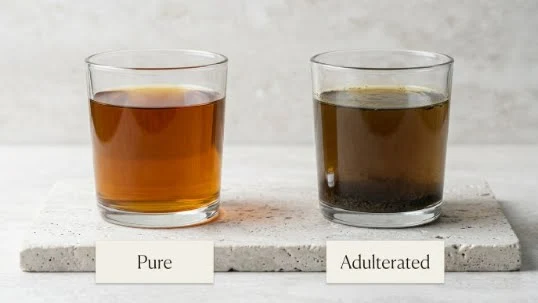
One nuance worth understanding: very occasionally, high-quality Shilajit from mineral-rich regions may leave a barely perceptible fine sediment. These are naturally occurring inorganic minerals, not adulterants. The difference is texture – natural mineral traces are extremely fine and uniform, whereas adulteration tends to produce a gritty, sandy, or oily deposit that is clearly visible and does not dissolve even with continued stirring.
The Honest Limitation: What This Test Cannot Tell You
The warm water purity test is a useful first filter. It is not a comprehensive quality assessment. In practice, a skilled adulterator could engineer a fake product that passes the visual water test by using soluble fillers. What the water test cannot measure includes:
- Actual fulvic acid concentration (only a lab test can quantify this)
- Heavy metal content – arsenic, lead, mercury – which are a genuine concern in unprocessed Shilajit
- Microbial contamination
- Percentage of active dibenzo-alpha-pyrones
This is why, if you’re buying Shilajit for regular supplementation, always ask the brand for a Certificate of Analysis (COA) from an independent, NABL-accredited laboratory. In India, look for FSSAI registration on the label as a baseline trust signal, and prioritise brands that voluntarily share batch-specific lab reports. No reputable brand should hesitate to provide one.
Complementary Home Tests at a Glance
While the warm water test is the most accessible, combining it with one or two of these secondary checks gives you a stronger overall picture:
- Pliability test: Pure Shilajit softens and becomes sticky in your hands within a minute or two. It should feel like warm resin or very thick honey – never brittle or powdery at room temperature.
- Flame test: A small amount on a metal spoon held over a flame should bubble and produce a small amount of white ash – it should not catch fire or produce black carbon smoke.
- Alcohol test: Pure Shilajit does not dissolve in ethyl alcohol – it forms clumps or remains intact. This is the opposite of its behaviour in water.
Interestingly, the alcohol insolubility is one of the more reliable differentiators because it’s harder to fake – most synthetic adulterants are soluble in both water and alcohol.
What to Do If Your Shilajit Fails the Test
If your liquid Shilajit leaves significant residue, produces persistent foam, or refuses to dissolve evenly, the most constructive steps are:
- Contact the brand and request a third-party COA for the specific batch you purchased.
- If no COA exists, consider returning the product or filing a complaint through the FSSAI consumer portal.
- Look for brands with verifiable FSSAI registration, GMP-certified facilities, and publicly accessible lab reports before repurchasing.
While research on standardised Shilajit quality markers is still evolving, what is well-established is that fulvic acid content is a key purity and potency indicator. Brands investing in transparent fulvic acid quantification testing are generally the ones worth trusting.
Frequently Asked Questions
Does liquid Shilajit dissolve faster than resin in warm water?
Yes, generally. Because liquid Shilajit has already been processed to a lower viscosity and is partly pre-dispersed, it typically begins dissolving almost on contact with warm water. Resin form may take up to 5-10 minutes to fully dissolve. Both should dissolve completely – the difference is just timing.
My water turned black, not golden. Is that a bad sign?
Not necessarily. Colour can range from golden-amber to dark reddish-brown to near-black depending on the concentration, grade, and origin of the Shilajit. What matters more is uniformity – the colour should be consistent throughout the solution, not patchy or swirled with different colours.
Can I use tap water for the warm water test?
You can, but filtered or purified water gives a cleaner baseline. Tap water in many Indian cities contains minerals and chlorine that can occasionally produce a small amount of cloudiness or fine residue on their own. For a more accurate test, use RO-filtered or bottled water.
Can a fake Shilajit pass the warm water test?
A sophisticated fake using water-soluble fillers (such as dark molasses, caramel colouring, or soluble humic extracts) might pass the basic visual test. This is why the warm water test should be one of several checks – not your only one. The alcohol test and a request for a COA are important secondary verifications.
Is the warm water test enough to confirm Shilajit is safe to consume?
No. Safety – particularly regarding heavy metals like lead, arsenic, and mercury – can only be confirmed through laboratory analysis. The warm water test tells you about physical purity and solubility, not chemical safety. For regular supplementation, always use a product backed by a third-party lab report.
What is the ideal fulvic acid percentage in quality liquid Shilajit?
While research is still evolving on a definitive standard, most quality-focused brands in India aim for a fulvic acid content of 40-60% as measured by UV spectrophotometry. Some premium formulations exceed this. Look for this figure on the COA – it’s one of the most meaningful markers of potency.